
The Responsive Diamond Model
Beyond Frameworks: Redesigning Your Building's Instructional Engine.
If your current MTSS feels like a series of disconnected silos, it’s likely because your Tier 1 is too static. The Responsive Diamond Model is more than a framework—it is a structural redesign that moves the "Differentiated Core" from concept to a daily reality.
We turn a shared commitment to every student into systems that hold across the full 1st-to-100th percentile range of your classrooms.
Why the Triangle Stopped Working
For two decades, the MTSS pyramid taught schools to picture support as a triangle: a wide Tier 1 base, a narrow Tier 2, a small Tier 3 point. The shape was never literal. But it trained educators to treat intervention as something layered above the core — escalating add-ons for students who fall behind.
That model breaks in the modern classroom. The triangle assumes a wide, uniform base — one the core can serve with a single level of instruction. But today's Tier 1 holds the full 1st-to-100th percentile range at once, closer to a one-room schoolhouse than a grade level. When the core is built for an average that no longer exists, it's the middle — roughly the 21st to 80th percentile — that goes quietly underserved.
The Responsive Diamond Model changes the shape. A diamond widens where the triangle narrows: the largest, most consequential work happens in the middle, inside Tier 1, every day. It tapers at both ends — toward the intensive 1–20% who need clinical support, and toward high achievers who need acceleration, not repetition. The shape now matches the room.
What the Model Actually Is
The Diamond Model is not a replacement for MTSS or a new tier structure. It is a redesign of how Tier 1 is delivered, so the core itself becomes responsive — able to meet a wide range of needs without pushing students out to a separate block.
Most frameworks name what should happen: differentiation, data, fidelity. Few resolve the how. The Diamond Model closes that gap. It makes the "Differentiated Core" a daily, observable reality — small-group, responsive instruction as the default, not the exception.
Three ideas hold it together:
Responsive frequency. Traditional models move students between tiers at predetermined intervals — long enough to lose a third of a year before the system reacts. The Diamond Model shortens the loop. Groups are fluid, reviewed on a tight cycle, and adjusted on current data, not the last benchmark.
A strengths-based middle. The 21–80% cohort is a priority group with its own design, not the students left over after intervention is assigned. This is where a building's largest gains usually hide.
Acceleration as a real tier. The top of the diamond serves students who have mastered the core and need to move ahead. A responsive system plans for them too — otherwise "high-fidelity Tier 1" just means the strongest students wait.
The Differentiated Core in Practice
The engine of the model is the Tier 1 classroom itself. Instead of whole-group instruction broken by occasional pull-outs, the room runs on high-fidelity blended learning across three pillars:
“Not flagged, not failing, assumed fine. They rarely are.”
The concept is easy; most leaders can describe station rotation. The difficulty is managing it — keeping independent stations productive while the teacher runs a focused group, and building routines that survive a substitute or a mid-year staffing change. That operational layer is what separates a model on a slide from one in the building.
Four Questions That Keep It Honest
A responsive core stays precise when instruction answers four questions — continuously, not at benchmark windows:
What do we expect every student to learn?
How will we know they have learned it?
How will we respond when they have not?
How will we extend learning for those who already have?
Most systems skip the fourth. It is exactly the question the top of the diamond answers. A framework that only plans for struggle is still a triangle.
Want to see how your building answers these four? Find out in two minutes.
From Data to Action
The model is only as responsive as the data cycle beneath it. It replaces the slow, compliance-driven review — collect, report, file, repeat — with a tight, action-oriented rhythm.
In practice: short, recurring review cycles. On a cadence the building sets and holds, teams review student movement, regroup on current performance, and commit to specific pivots before the next cycle. The interval is calibrated to the school — short enough to catch a stalling student early, long enough to test whether a change works. Held consistently, the cycles compound into a building that adjusts continuously instead of lurching between benchmarks.
“A model only lasts if the building sustains it — through ongoing support, not a one-time rollout.”
Instructional leaders are in classrooms regularly: observing, giving feedback, and coaching teachers in the evidence-based practices a blended Tier 1 depends on. A short, observable checklist of 'look-fors' tells leaders at a glance whether the model is holding or slipping — and anchors the coaching that follows.
How It Scales
No building flips to a responsive core overnight, and mandating it school-wide on day one is the most common way these efforts fail. The model scales in phases:
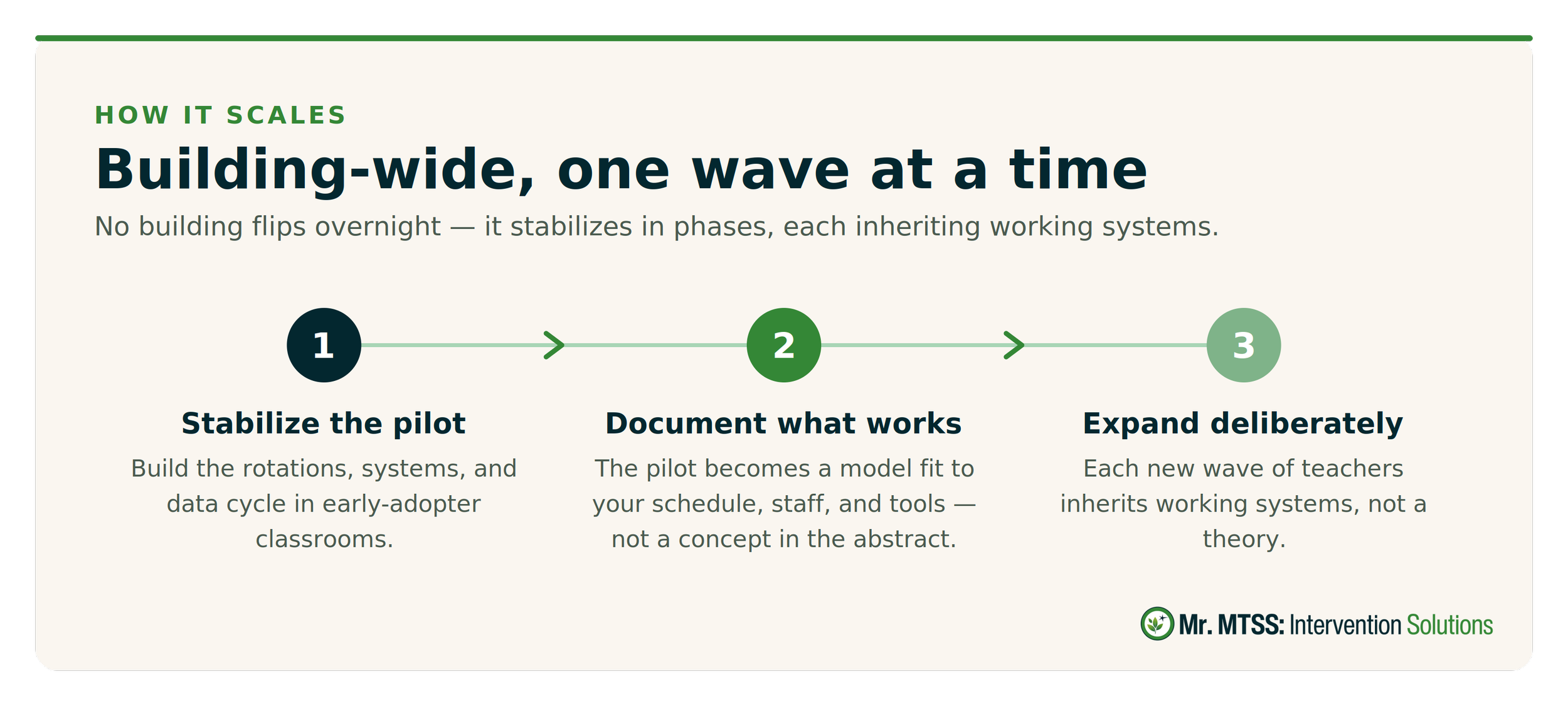
That is the difference between a PD day forgotten by November and a change that survives staff turnover and shows up in next year's data.
Common Questions
Is the Diamond Model different from MTSS or RTI? No — it works inside MTSS. RTI and MTSS define the tiers; the Diamond Model defines how Tier 1 is delivered, so the core can serve the full range of learners. It is the operating system, not a replacement for the hardware.
Does this mean abandoning Tier 2 and Tier 3? No. The intensive 1–20% still need clinical, targeted intervention, and the model protects that work. A stronger Tier 1 simply stops sending students to intervention who never needed it — freeing capacity for those who do.
Who is it for? Building and district leaders whose MTSS has become disconnected silos, and who want Tier 1 to do more of the work it was meant to. It runs on existing staff, not a new department.
How long does it take? The Precision Roadmap is a 12-month engagement built around a recurring review cycle the building sets and holds. Building-wide stabilization is a year-long change, not a one-day training.
Where to Start
The Diamond Model makes a promise the triangle could not: the student in the middle — neither failing nor flagged — gets a path forward as deliberate as the one built for students at the edges. Mr. MTSS brings two decades of school and district leadership to that work.
From Static Tiers to Fluid Systems
The Success Suite provides the tools; the Responsive Diamond Model provides the Blueprint. We deliver the "how" through three strategic services:
1. The Structural Diagnostic
We don't just audit for compliance; we audit for flow.
Barriers to Response: We identify exactly where your current master schedule or technology stack inhibits "Responsive Frequency."
Gap Calibration: A clinical look at how your 21–80% cohort is being prioritized without sacrificing the intensive needs of the 1–20%.
The Success Suite Edge: Targeted recommendations for specific Mr. MTSS tools to automate your data review and progress monitoring.
2. The Professional Blueprint (Live or Virtual)
Training that focuses on the mechanics of the room.
The Three-Pillar Shift: Moving staff from whole-group instruction to high-fidelity rotations: Teacher-Facilitated, Technology-Supported, and Collaborative.
Adaptive Classroom Management: Practical systems for maintaining student engagement in independent stations while the teacher drives clinical intervention groups.
Data-to-Action Protocols: Moving beyond quarterly testing to real-time, responsive instructional pivots.
3. The Precision Roadmap
A 12-month commitment to building-wide stabilization.
"Responsive Review Cycles": We establish the rhythmic habit of reviewing student movement and adjusting groups on a cycle the building sets and holds.
Administrator "Look-Fors": A tactical checklist for leaders to verify fidelity without needing to be literacy experts themselves.
Scaling the Pilot: A phased plan to move from early-adopter classrooms to a stabilized, building-wide framework.
Exploring?
See where your Tier 1 stands in two minutes.
Ready to start the conversation?
Schedule a 30-minute Discovery Meeting to talk through what's in place at your school and learn whether the Responsive Diamond Model is a fit.